Alexandria's founded by Alexander

Alexandria's founded by Alexander the Great (by year BC): 334 Alexandria in Troia (Turkey) - 333 Alexandria at Issus/Alexandrette (Iskenderun, Turkey) - 332 Alexandria of Caria/by the Latmos (Alinda, Turkey) - 331 Alexandria Mygdoniae - 331 Alexandria (Egypt) - 330 Alexandria Ariana (Herat, Afghanistan) - 330 Alexandria of the Prophthasia/in Dragiana/Phrada (Farah, Afghanistan) - 330 Alexandria in Arachosia (Kandahar, Afghanistan) - 330 Alexandria in the Caucasus (Begram, Afghanistan) - 329 Alexandria of the Paropanisades (Ghazni, Afghanistan) - 329 Alexandria Eschate or Ultima (Khodjend, Tajikistan) - 329 Alexandria on the Oxus (Termez, Afghanistan) - 328 Alexandria in Margiana (Merv, Turkmenistan) - 326 Alexandria Nicaea (on the Hydaspes, India) - 326 Alexandria Bucephala (on the Hydaspes, India) - 325 Alexandria Sogdia - 325 Alexandria Oreitide - 325 Alexandria in Opiene / Alexandria on the Indus (confluence of Indus & Acesines, India) - 325 Alexandria Rambacia (Bela, Pakistan) - 325 Alexandria Xylinepolis (Patala, India) - 325 Alexandria in Carminia (Gulashkird, Iran) - 324 Alexandria-on-the-Tigris/Antiochia-in-Susiana/Charax (Spasinou Charax on the Tigris, Iraq) - ?Alexandria of Carmahle? (Kahnu)
Showing posts with label Central Asia. Show all posts

Monday, September 16, 2024

Alexander’s presence in Venice – Part 4, the Doge’s Palace

Who would check every detail of the Palace of the Doge in Venice, except the dedicated scholar? None of the millions of tourists has the patience or dedication to investigate, beyond the general overview. 

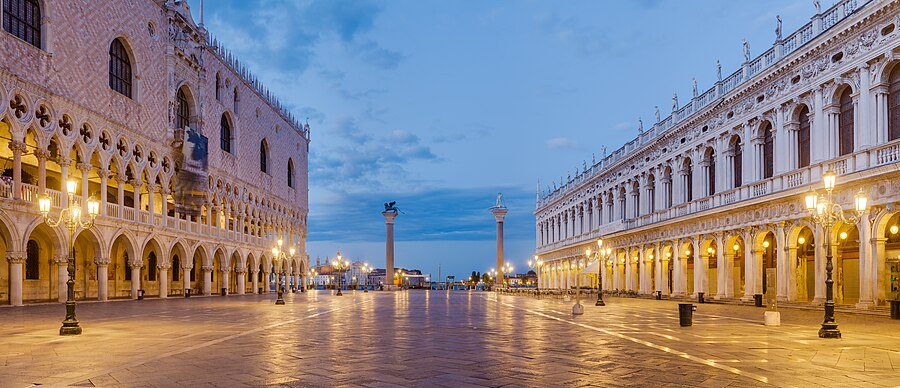
[San Marco Square, Doge's Palace on the left]

The Palace was built in the 12th century. The concept is atypical, displaying a smooth wall with a geometric pattern of white and pink stone, which rests upon two levels of colonnades. At ground level this is an arched white stone colonnade; on the first floor, it is a loggia enhanced with quatrefoil openings in white Istrian stone. The top of the Palace is crowned with white lace stonework merlons as seen in Persepolis and Central Asia. 

The capitals on top of the columns are all different and have many stories to tell. They serve not only as decorations but also as examples of historical, moral, and political teaching. We will recognize biblical scenes, Christian virtues, medieval symbolism, the Twelve Signs of the Zodiac, aspects of everyday life, and people of the world. 

[Doge’s Palace, south facade, Alexander the Great, ca. 1350 from Engramma]

It is in this last group that Alexander the Great pops up with the inscription ALEXANDER MACEDONIAE REX as one of the Kings of the World. He is to be found on top of the fifth column counting from the Ponte della Paglia. The picture from Engramma is not the best but is the only one available. It will have to do…

Saturday, February 4, 2023

Afghanistan, where history keeps repeating itself

The war in Afghanistan is no longer making headline news since the U.S. withdrew its troops in a sudden and short-term operation. What’s new, we might ask. The answer is nothing. 

Alexander spent three years of his life in Central Asia fighting an ever-elusive enemy of tribes that no longer fought each other but joined forces against the invader. In the 5th century, the Huns wreaked havoc; Genghis Khan, at the head of the Mongols, rampaged the region in the 13th century; Tamerlane repeated the operation a century later; and the Mughal dynasty followed suit in the 16th century. Even Islam spreading brotherhood among men could not achieve any result. The more recent invasions by Britain in 1839-1842 and 1870-1880, the Soviet Union in 1979-1989, and the United States in 2001-2021 only repeated their predecessors’ fatal outcomes.  

Who are we to call Alexander’s campaign in Central Asia a failure when later invaders with far more sophisticated means did not fare any better? Alexander was a military genius, and no one has been able to surpass him – certainly not here in Afghanistan. 

Those looking for a complete analysis on the situation in Afghanistan will find useful information in Frank Holt’s book Into the Land of Bones, Alexander the Great in Afghanistan. The author draws an excellent comparison of Alexander’s achievements with those of later invaders. He asserts that the only way to rule the country should imply that the conqueror subdues every warlord because one single exception would erase all previous successes. Isn’t that precisely what Alexander tried to achieve? 

The French archaeologists who worked in Afghanistan early in the last century, upon the invitation of King Mohammed Zahir, were confronted with the double face of the local population. During the day, they gathered around to look and give a helping hand, while at night, they would destroy the statues and steal the precious artifacts. Tribal elderly, generally strong Islamic believers, destroyed many human statues as soon as they were unearthed. Altogether, many unique artifacts were destroyed overnight or disappeared on their way to the Museum in Kabul (see: Le trésor perdu des rois d’Afghanistan by Philippe Flandrin). Typically for Afghanistan, not even the king could overrule the tribe's elders! 

Under these circumstances, it is impressive that the gold treasure from Tillya Tepe, a tomb hill in the northwest corner of Afghanistan, has survived. The content of these six tombs was barely rescued when the Soviet Union entered Afghanistan in 1979 and safely transferred to the Museum in Kabul (see: Bactrian Gold, the Hidden Treasures from the Museum of Kabul). The Museum suffered greatly from the ensuing civil wars and was repeatedly plundered, and artifacts were stolen. The worst, however, was still to come when, in 2001, the Taliban decided not only to destroy the huge Buddha statues at Bamyan but also to annihilate the 2,500 statues and reliefs of the Museum. However, a handful of brave Afghans rescued the Tillya Tepe treasure and locked it away in the vaults of the Presidential Palace. They managed to keep the place a secret. By 2004 the government of Afghanistan decided that the situation was safe enough to bring the gold artifacts out in the open again, but the Museum in Kabul was no longer fit to shelter this precious collection. Based on their earlier collaboration, they contacted the Musée Guimet in Paris and, together, they agreed to send these rich finds on a traveling tour around the world. 

Today, with the ruling Taliban, the country is still dominated by its warlords, who consistently cling to their traditions and mistrust all foreign intrusion.

Thursday, December 22, 2022

Origin of the tin ingots from Uluburun

It largely remains an open question of how much Alexander knew about the lands he set out to conquer. The answer or answers keep amazing me. 

Imagine that Alexander was familiar with the trade routes of the precious minerals like copper and tin that existed nearly one thousand years before he was born. Today, we would say it is rather obvious, but is it? 

Merchants were always very innovative and perseverant in exploring and finding new markets for their goods to be sold at the highest prices. The shipwreck of Uluburun was a true eye-opener, exposing the variety of wares from distant countries that were traded mainly around the Mediterranean. 

In my earlier blog, The flooded remains of Kekova Island and Uluburun, I mentioned that the ship was on its way from Egypt to the Black Sea when it sank off the coast of Uluburun in modern Turkey. It carried, among others, 10 tons of copper ingots from Cyprus and an unspecified number of tin ingots from Persia. 

It was lengthy to bring the cargo from the Uluburun ship to the surface, as it took 22,430 dives. The precious finds are now safely exhibited inside the Museum of Bodrum Castle, surrounded by lively reconstructions of the ship’s haul. I somehow missed spotting the tin ingots as I focused on the copper and glass ingots instead. 

It is common knowledge that copper and tin are needed to make bronze. Since the second millennium BC, bronze has been in high demand to create tools and objects of prestige, but most of all for weapons. It is noteworthy that the Uluburun ship held enough metal to supply swords to 5,000 soldiers! 

A recent study published in The Past established that two-thirds of the 105 tin ingots originated from the Taurus Mountains in Turkey, and one-third were traced back to Tajikistan and Uzbekistan. These two countries are roughly 3000 kilometers east of Uluburun! 

During the Bronze Age, the mines of Central Asia were local operations led by small mobile villagers. Tin from the Musiston mine traveled over rugged and rough terrain to Haifa - a distance of more than 3,000 km – before it was shipped across the Mediterranean.

Saturday, August 6, 2022

Hidden treasures of Central Asia

In a recent article, The Greek Reporter focused on the achievements of the prominent archaeologist Viktor Sarianidi (which they misspelled as Victor Sarigiannidis). 

His name is closely tied to the excavations at Tillya Tepe in Afghanistan, which had to be interrupted when the USSR invaded the country. The treasures from that tomb were safely transferred to the Museum of Kabul for safekeeping. When the Taliban rose to power in 2001, they decided to destroy the 2,500 statues and reliefs kept at the Museum. The Afghans managed to move and hide the precious artifacts from the tomb. In 2004, the government of Afghanistan decided the situation was safe enough to bring the gold treasures out in the open again. As the Museum in Kabul could no longer shelter this precious collection, they agreed with the Musée Guimet in Paris to send these rich finds on a traveling tour (see: Bactrian Gold, the Hidden Treasures from the Museum of Kabul). The Greek Reporter mentions that the artifacts have instead disappeared!

[Picture from The Telegraph, CREDIT: ©Thierry Ollivier / Musée Guimet]

Viktor Sarianidi lived an interesting life, to say the least. He was born in Tashkent, then USSR, and now Uzbekistan, to Greek parents. His archaeological career took off in 1949, and he excavated actively in Central Asia and Afghanistan. At this time, he exposed the necropolis of Tillya Tepe. It is noteworthy that Sarianidi proved the intercultural influences of the findings with links to Greece, Iran, India, Egypt, China, and even Siberia! The most striking example is the cute little Greek goddess Aphrodite, complemented with wings conforming to local winged deities and the dot on the forehead that shows influence from India

Sarianidi spent the last 30 years of his life excavating in the Desert of the Karakum in Turkmenistan, where he discovered the hitherto unknown Margian Kingdom (end of the 3rd millennium BC). This discovery earned him the Honorary citizenship of Turkmenistan in 2000. Three years earlier, he had received Greek citizenship. These rewards have led to widespread confusion about his nationality, and he is quoted alternatively as Russian, Greek, or Turkmen. 

[Kyzylkum Desert and Oxus River]

With such a background, he promoted the Greek presence in the greater Black Sea area and identified Greek roots in modern Afghanistan, Turkmenistan, and Uzbekistan. Sarianidi also developed a theory that Hellenism (I believe he means Greek) influences reached Central Asia some 1600 years before Alexander the Great arrived on the scene. This means that the culture of the Oxus River could be associated with the Minoan-Mycenaean culture. He was a prolific writer, and his books have been translated into English and Greek. 

The Greek Reporter further insists that Sarianidi discovered “the city” of Bactria! This is very confusing because Bactria was a region in Central Asia, and its capital was named Bactra, modern Balkh. Linking Bactra and the vast necropolis of Gonur Tepe apparently confirms Sarianidi’s theory that Greek influences (not Hellenism) were present many centuries before Alexander conquered Central Asia.

Wednesday, January 26, 2022

Who is Alexander? Part II


Alexander heads for Asia at twenty-two, leaving Macedonia in the hands of his father’s trusted general Antipater as Regent. He sets out with an army of about 40,000 infantry and 5,000 cavalry. The gods are with him all the way. The first opposition happens in a tiny corner of Asia Minor, on the banks of the Granicus River. Darius III, King of Persia, King of Kings, believes that his presence is not required and merely delegates the confrontation to a mercenary in his service, a Greek on top of that, called Memnon. Well, Memnon, although a highly skilled general and Alexander’s most formidable opponent, is defeated. Nothing can stop Alexander now from taking one city after another, one port after another, all along the west coast of today’s Turkey. 

A year later, Alexander will face King Darius in person at the Pinarus River near Issus. The Persian army was huge compared to the Macedonian, but it was outmaneuvered during the first minutes of the battle. King Darius panics and flees into the backcountry. By leaving the battlefield, Alexander automatically emerges victorious. 

Both kings meet again, two years onwards, in a decisive confrontation on Persian soil near Arbela, a place better known as Gaugamela. It is a fight worthy of David and Goliath, where Alexander, with his 50,000 men, stands up against Darius’ troops, which may be 250,000 and has been exaggerated to 500,000. Whatever the numbers, his opponent counted many times more soldiers than his own force! From the tactical point of view, the battle proves to be such prowess that it is still taught at the Military Academy of West Point today. Alexander attacked an empire that was ten times bigger than his! 

Alexander’s accomplishments reached far beyond winning battles. He took on the organization of the entire enterprise, working out the logistics, relentlessly inspiring his army, and caring for all involved. Everyone looked up at him for guidance. 

Alexander’s empire extended from Greece to India and from Uzbekistan to Egypt at the height of his power. His army and baggage train in Asia must have counted at least one hundred thousand men. This mass of people inevitably included merchants, peddlers, blacksmiths, tailors, stone cutters, shipbuilders, entertainers, carpenters, cooks, architects, masons, road builders, and whores. Alexander managed to take his dismantled ships and catapult towers with him on the road so he could assemble them whenever needed. The word prefab was invented only eons later. 

The king moved all these people through the scorching deserts of the Karakum and the Gedrosian. He took them over the snow-capped mountains of the Zagros and the Hindu Kush. Also across swift-running rivers such as the Euphrates and Tigris, Oxus and Jaxartes, Indus, and entire Punjab. Just try to picture that crowd of soldiers, horses, followers, and equipment trudging through uncharted territories. It is dazzling! 

Alexander organized a government adapted to each and every land and tribe he conquered. He founded cities at strategic trade-road crossings, many of which still exist today. His task was absolutely colossal, and Alexander always was the driving force. Alexander also was a visionary, one we would love to have around today. He welded the world into one country.

Neither his Macedonians nor the Greeks were ready to comprehend the grandeur of his conquests, their vastness or scale. He made excellent use of the accumulated treasuries kept in the Royal Persian vaults, minting vast amounts of gold, silver, and bronze coins. The coins had Alexander’s image stamped on them, which was a somewhat new concept for until then, only gods were worthy of such a favor. The Alexander coins were known and accepted all over the empire. It was the euro of antiquity! 

Finally, there is Alexander’s legacy, i.e., the impact of Greek fashion, culture, and art on the occupied territories – a phenomenon that went down into history as Hellenism. From Athens to the Indus, the official language was Greek and remained so for nearly one thousand years until Islam took over with the use of Arabic. We owe it to Hellenism that the first statues of Buddha were made, that the first Library of Alexandria in Egypt was created, and that the Romans rose to power. Christianity spread so smoothly thanks to the usage of Greek, and the Renaissance is nothing less than a renewed connection with Hellenism. 

All of Alexander’s cities were built according to the Hippodamian plan with right-angled streets, including familiar buildings like temples, gymnasiums, agoras, theaters, and stadiums. Alexander’s love for games, sports competitions, and theatre contests with playwriters and actors traveling thousands of miles is another tradition that was continued for centuries deep into Central Asia and India. 

Our world would not be what it is today had it not been for Alexander. No other man in history impacted the world as much as Alexander the Great. Nobody conquered and ruled at the level of Alexander’s high standards, and nobody ever will.


Please consult my book for the full story of his conquests and achievements: "Alexander the Greatwas here, and so was I.”

Friday, October 15, 2021

An introduction to the Scythians

The Scythians are mentioned in different contexts throughout my blog, but they have never been discussed as a people. 

[Picture from World History Encyclopedia.  A map illustrating the expansion of the warrior nomad Scythians between the 7th and 3rd century BC across Asia and Europe. (Simeon Netchev - CC BY-NC-SA)]

We have to go back to Herodotus in the 5th century BC, who mentions the Scythians for the first time. The author concentrates on Ukraine, although his description might well extend to the tribes in Central Asia. When talking about the Scythians, we refer to many different tribes roaming the steppes north of the “civilized” world. Their habitat stretched roughly from the Black Sea, the Caspian Sea (north of Persia) to Central Asia and the desert of Mongolia. At this far easterly end, the Chinese protected themselves from Scythian invasions by building their famous Great Wall. 

Generally living in small bands, they attacked the cities and towns situated south of their extensive east-west frontier. After a more or less sudden devastating incursion, they would withdraw with their booty into their vast nomadic Eurasian steppe lands. Over the years, some tribes settled as farmers, but they were not interested in founding cities of their own. 

In Central Asia and Persia, the Scythians were called Sacae as both tribes shared the same Indo-European language and lifestyle. These Sacae are called Skudat, which the Persians understood as Sakâ. The Greeks, in turn, used the name Skythes or Skythai. No wonder the Scythians show up so often in history under a different disguise. 

The Persians suffered repeated attacks from the Scythians, who, even shortly, dominated the Medes in the 7th century BC. They are also known to have played a significant role in the Sack of Nineveh in 612 BC. 

As a result of Miletus’ colonization, the Kingdom of the Bosporus emerged (see: The Kingdom of the Bosporus). It reached its peak between the 6th and the 3rd century BC. During that period, the new settlers maintained strong cultural and trade relations with the Scythians. Over the centuries, the kingdom with its capital of Panticapaeum became a melting pot of civilizations as the Greeks mingled with neighboring Pontic Scythians. 

An earlier blog, A cast helmet from Central Asia, discussed a helmet found near Maracanda, in the tomb of a Sacae leader. The technique of cast helmets was customary in China, which proves that these nomadic Scythians lived far to the east. This particular helmet dated from the 6th century BC and became obsolete afterward. 

The Massagetai tribe living near the Aral Sea was also Scythian. In 529 BC, Cyrus the Great attacked this tribe, ruled by Queen Tomyris. That happened after Cyrus’ negotiation to marry her failed. She bluntly refused to submit to him. As a result, the king attacked her and her tribe, and she died on the battlefield. 

The Scythians also successfully withstood Darius the Great’s attack at the beginning of the 5th century BC. Later that century, the Pontic Scythians took possession of Thrace. 

In the 5th century BC, the Odrysian Kingdom was founded – merely a union of more than forty tribes that turned Thracia into a powerful state. The Odrysians and the Scythians had reached peaceful relations through their inter-dynastic marriages, which led to establishing the border of their lands at the Danube River. Both peoples mingled and were generally recognized as Scythians. Their agreement, however, was not meant to last as, in the end, southern and central Thrace were divided among the Odrysian kings. Eventually, Philip II conquered their land in 340 BC. The Getae ruled the northeast section. 

Alexander attacked these Getae after his pursuit of the Triballians to the banks of the Danube River in 335 BC. The Triballians had sought refuge on an island. Instead of attacking them in that awkward position, Alexander decided to isolate them and go after the Getae on the other bank of the Danube. He managed to ferry 4,000 infantrymen and 1,500 cavalry across the wide river by night. No wonder the Getae were in shock when they woke up with this army on their land and fled to the hinterland (see: Crossing the Danube River). 

A noteworthy Odrysian Thracian is Sitalces. His true origins remain relatively obscure, but apparently, he was a prince, maybe even the son of King Cersobleptes of the Odrysian Thracians. He joined Alexander’s army and proved to be a competent commander who led the Thracian javelin men on more than one occasion. The Thracians appear again at the Battle of Gaugamela. They were placed with the main body of the Macedonian troops, under the command of Sitalces once again (see: Sitalces, commander of the Thracians). Sitalces was also one of the three generals who, on Alexander’s orders, executed Parmenion in Ecbatana (see: The Philotas Affair – Part II – His judgment and execution). 

Back in Central Asia, we should mention the story of a Scythian chief named Karthasis, who offered one of his daughters – most probably one of those warlike Scythian young women - in marriage to Alexander. The King declined, but the story may well have triggered the tale of the Amazons. 

In 329 BC, Alexander marched north to Cyropolis, a city founded by Cyrus the Great. But Cyropolis was situated about 10 km away from the Jaxartes River. Alexander felt that it didn’t serve his purpose, i.e., to protect the country against the nomads inhabiting the lands beyond the majestic river. He decided to build a city of his own, Alexandria-Eschate or Alexandria-the-Furthermost (Ultima), right on the banks of the Jaxartes – the location of today’s Khodjend in Tajikistan. Shortly after starting his project, a general revolt broke out, and the entire area exploded into armed resistance, making it clear that the Macedonians were not welcome. The Scythians on the opposite shore of the Jaxartes also grew furious. Consequently, Alexander set the crossing of the river in motion. He conceived a flotilla of large rafts made of stuffed leather tent covers, rigged together and covered with a sturdy platform. These rafts could carry a heavy contingent of men and even horses. Besides, Alexander equipped them with long-range catapults, a kind of machine the Scythians would discover for the first time.

When the Scythians recovered from their first shock and surprise, they played their favorite maneuver by riding and attacking in circles. Alexander threw in a mixed force of infantry and cavalry and successfully broke the circle, sending the Scythians to retreat after being hunted down by Alexander for several miles into the desert (see: Alexandria-Eschate and Cyropolis). 

The above gives insight into the Scythians' link between Greece, Persia, India, and China. It may somehow have laid the foundation of the Silk Road as a vast trade network. 

Although the Scythians have no written records, they left us substantial archaeological evidence of their high skills in metalwork. Monumental burial mounts across the Eurasian steppe reveal high-quality jewelry, weapons, vessels, horse harnesses, belts, and other decorative items, mostly made of gold. 

Inevitably, some of these Scythian tribes, such as the Pontic Scythians, settled as farmers, while others kept roaming the vast steppes from Mongolia to the Black Sea area. In the early Middle Ages, the most westerly tribes blended in and mixed with the early Slavs.
Thursday, April 29, 2021

First contacts with China

It is generally not mentioned that in the wake of Alexander's expansion, an opening towards China, or Seres as Strabo called the country, was created to the east of Central Asia. After all, in 329 BC, the king founded the city of Alexandria Eschate (very appropriately being Alexandria the Furthest), the later Khojend in modern Tajikistan, where he stopped his march eastwards. 

His Greek settlers in Central Asia were there to stay for the next three hundred years as Seleucos established his Empire, which later became the Graeco-Bactrian kingdom. Over time, their kings steadily expanded their power further to the east, and the main force appeared to be King Euthydemus (230-200 BC). This Euthydemus was born in Magnesia, Asia Minor as the son of the Greek general Apollodotus. By 209 BC, as Graeco-Bactria king, he withstood the three-year-long siege of Bactra led by the Seleucid ruler Antiochus III. In the end, Antiochus offered one of his daughters in marriage to Demetrius, son of Euthydemus, in exchange for which he received several Indian war elephants. 

Once well settled, Euthydemus went to the lands beyond Alexandria Eschate. As reported by Strabo, he even reached Kashgar in the region of Xinjiang. This may date the first Western and China exchanges to around 200 BC. 

How China looked at the West is a much lesser-known story. Not unlike the Greeks, the Chinese held that they were the center of world civilization and that all other countries were tributaries of China. This implies that the campaign of Euthydemus may have been a significant turning point (see also: Alexander's influence reached all the way to China?)

Around 130 BC, embassies of the Han Dynasty traveled to Central Asia as the Chinese emperor Wudi was interested in the sophisticated civilizations of Ferghana, Bactria, and Parthia, respectively known to the Chinese as Dayuan, Daxia, and Anxi. Since then, numerous embassies left every year to these countries, where they found people living in fixed homes and interested in the rich produce of China. Chinese records reveal that more than ten such missions were dispatched into Parthia, Seleucid Syria (known as Lijian), Chaldea (Tiaozhi), and north-western India (Tianzhu). Allegedly, they even visited Emperor Augustus (27 BC – 14 AD), and it seems hard to imagine Chinese envoys walking in the streets of Rome! 

Roman soldiers also made their way east, although not out of their free will. It has been documented that soldiers captured by the Parthians were dispatched to defend their eastern borders. In 54 BC, Pliny mentioned that after the battle of Carrhae in 53 BC (see: Harran, better known under its Roman name Carrhae), the Parthians sent some 10,000 prisoners to Margiana to man the frontier. Chinese sources report that these soldiers had blond hair and blue eyes. Eventually, these troops were captured by the Chinese to founding the city of Liqian or Li-Chien – a transliteration of Alexandria - it seems, in the region of Gansu in western China. Several inscriptions discovered in the Kara-Kamar caves on the border between eastern Uzbekistan and Turkmenistan were written in Bactrian, Greek, Arabic, and Latin. The latter was composed of three lines and was left by the Roman soldiers of the Pannonian Legio XV Apollinaris around the 2nd century AD. Notably, this cave complex showed remarkable similarities with temples dedicated to the god Mithras, who was featured in killing the bull. This secret male cult started about the 1st century AD and soon spread with the legionnaires over the entire Roman Empire. 

By the first century BC, Rome started showing serious interest in the precious silk it received through trade with the Parthians. Wearing silk soon exploded, but it was not met with overall approval. Seneca (3 BC-65 AD) complained that silk did not hide the body, not "even one's decency." This led the Senate to issue an edict prohibiting silk-wearing, which the wealthy Roman elite liked to ignore. Besides the moral ground, this edict also had an economic reason, as importing silk caused a massive outflow of gold. 

Yet, business is business, and the trade prospered. Over land, using the Silk Road was a tedious and expensive operation, which was soon to be supplanted by a newly found maritime route. The ships would sail from China, stopping at ports in modern Vietnam, India, and Sri Lanka controlled by the Chinese emperors. The western end of this business route, with stopovers in Egypt and the Nabataean territories, was controlled by Rome. Their merchants traveled on Roman, Indian, and even Chinese ships. 

Best known from this period is the campaign led by the Chinese general Ban Chao, who in 97 AD crossed the Pamir Mountains with an army of 70,000 men to fight the Xiongnu, generally the people living in Central Asia. He even reached the Caspian Sea and the lands occupied by the Parthians. From here, the general sent an envoy to Dagin (Rome). Ultimately, this was Gan Ying, who stopped in Mesopotamia although he intended to sail to Rome via the Black Sea. The Parthian merchants wishing to safeguard their profitable position as the middleman between Rome and China, told Gan Ying that his planned trip would take him two years. In reality, this was two months. This is why the envoy decided to abandon his mission and return home. His merit, to a certain extent at least, was his account of Rome and Emperor Nerva, which he obviously based on second-hand information. However, he correctly reported that Rome was the leading economic power at the western end of Eurasia. The Chinese army settled for an alliance with the Parthians. 

The earliest documented Roman embassy to arrive in China dates to 166 AD. Chinese sources mention that it came from Antun (Antoninus Pius), king of Dagin (Rome). This information must be clarified since Antoninus Pius died five years before, in 161 AD. It is suggested that they meant Marcus Aurelius, who added the name of his predecessor to his own; he came to power in 166 AD. 

This Roman delegation probably arrived by sea and carried presents of rhinoceros horns, ivory, and tortoise shells originating from Southern Asia. More important, however, is that the Chinese acquired a treatise on astronomy. Roman cartographers knew of the existence of China since the country was mentioned on the map by Claudius Ptolemy in about 150 AD. The booming trade across the Indian Ocean in the 2nd century AD enabled the identification of Roman outposts in India and Sri Lanka. 

After a lacuna about further exchanges, the next documented account emerged in the 3rd century AD when the Roman Emperor (possibly Alexander Severus) sent presents of colored glass to Emperor Taitsu of the Kingdom of Wei (reigned 227-239 AD) in Northern China. The last record about an embassy from Rome dates from 284 AD when the envoys of presumably Emperor Carus (282-283 AD) brought "tribute" to the Chinese Empire. 

To summarize, contact between our western world and China lasted at least six hundred years after Alexander opened access to Central Asia. In all its aspects, the Silk Road sank into oblivion until Marco Polo revived this part of history in the 13th century, i.e., one thousand years later!

Friday, April 2, 2021

The complex site of Taxila

Until now, I pictured Taxila as one big city, as it is in modern times. What threw me off was that ancient sources talked about the three ancient cities of Bhir, Sirkap, as well as Sirsukh instead of Taxila. Meanwhile, modern archaeology has established that Taxila is composed of 18 separate sites of great cultural value. This demanded a closer and more in-depth study of the matter. 

From the 6th century BC onward, the city of Taxila was known by the Persian Achaemenid kings, who turned it into an important hub on their Royal Road from Persepolis to Central Asia. For AlexanderTaxila was the first major city he encountered on this way into India. It was also the residence of King Taxiles, who came to meet him while he was still in Sogdiana. He had promised to join his forces to those of Alexander, but he died before they could meet. True to his father’s word, Omphis (also called Mophis or Ambhi) received Alexander in Taxila (see: Alexander crossing the Indus at Ohind). 

We will recall that Omphis had provided supplies to Hephaistion and the Macedonians as they were bridging the Indus River. When both kings met outside the city, Omphis handed his fifty-six elephants over to Alexander, together with an impressive herd of livestock, including 3,000 bulls dressed up for sacrifices. 

The site of Bhir is actually the place where this meeting took place in 326 BC since Omphis palace stood on top of a mound that carried that name. This same location was later occupied by Chandragupta Maurya (see: Was Chandragupta inspired by Alexander?) and his grandson, Asoka. As the latter introduced Buddhism in the Gandhara region, the first Buddhist monastery was erected at this very spot at some time in the 3rd century BC. By the 2nd century AD, this construction was replaced by the Dharmarajika Stupa, the remains of which are still visible. 

With Alexander, Greek knowledge and science reached Taxila. Here, philosophers and the like met and developed science, mathematics and astronomy. 

Sirkap emerged at a later date. After Alexander’s conquest, the eastern part of his empire was ruled by the Seleucid kings till about 250 BC. By then, power was taken over by the self-proclaimed King Diodotus I of Bactria, who laid the foundations of what became the Greco-Bactrian Empire. These Bactrian Greeks advanced into the Gandhara region and erected their well-planned city of Sirkap as part of Taxila. For the next five hundred years, Greek remained the lingua franca and the influence of Greek art and beliefs lived on (see: Unique Hellenistic heritage in Pakistan). 

This link is confirmed by the Greek philosopher Apollonius of Tyana (15-100 AD), who described Taxila as being rich with Greek-type of constructions. This happened in the 1st century AD, and it is generally accepted that he was talking about Sirkap.

As a result of the heavy traffic on the Silk Road that connected Central Asia to China, business flourished while the population mingled with the Scythians, the Parthians, and later the Kushans. Besides silk and other precious goods, Buddhism also spread steadily in the wake of Buddhist monks travelling to China, Korea, and Japan. It was under the Kushan emperors that a new form of art blossomed, blending classical Greek expression with local art forms. This became known as the Gandhara Art, which produced the most remarkable statues of Buddha and Bodhisattvas (see: Indo-Greek art or the influence of Hellenism on Buddhist art). 

One of the oldest Stupas is the so-called Round Stupa from the 1st century AD. The largest sanctuary is the Apsidal Temple, measuring 70x40 meters with a square nave and several rooms used by the Buddhist monks. It also presented a building in an apsidal shape – hence its name. It may have been decorated by a Greek artist, but the earthquake of 30 AD destroyed most of the building. 

Of particular interest is the Double-Headed Eagle Stupa, which displayed pilasters of Greek design with Corinthian columns. It has a strange combination of a Greek temple and a Hindu shrine. The ensemble is crowned with a double-headed eagle as originally found in Babylon. The theory is that the idea spread to Scythia and was introduced to the Punjab by the Saka rulers. 

The large Dharmarajika Stupa already mentioned in Bhir was situated not far from Sirkap. It was built with the sole purpose of housing relics of the Buddha and was surrounded by several monastic buildings. 

The most recent city is Sirsukh, which was founded by the Kushans after 80 AD. King Kanishka had decided to abandon Sirkap and to build his own new city in a typical Central Asian style. The city was surrounded by a strong fortification wall that was almost five kilometers long and more than six meters thick. Its particularity was that the face of these walls was covered with diaper or diamond-shaped masonry. Until now, the city proper could not be investigated properly because today it is buried deep underneath the low, richly irrigated land. Sirsukh was completely destroyed by the Huns, who invaded the Punjab around 500 AD.